
The Turnout Story That Demands Explanation
When Philadelphia and Denver reported youth turnout increases of 12 to 15 percentage points over 2021 municipal elections, political analysts scrambled to explain what looked like straightforward good news: young people showing up. But this framing misses the genuinely interesting question. Young voters didn’t suddenly become civically engaged across the board. They mobilized around specific local ballot initiatives in patterns that previous generations rarely demonstrated. The mechanism matters more than the headline.

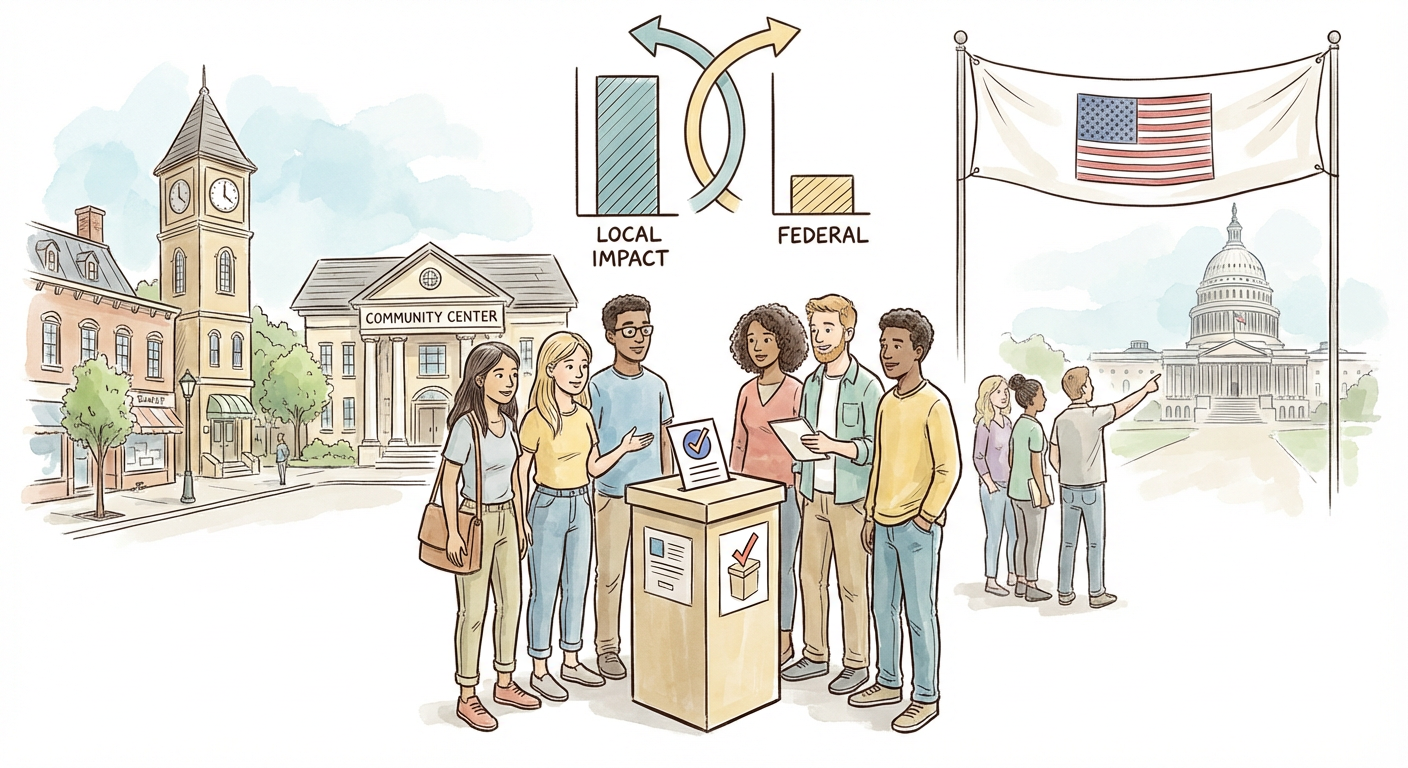
Compare this moment to the youth activism of the 1960s or even the 2008 Obama surge. Both saw young voters animated by national figures or sweeping ideological movements. What’s different in 2025 is striking. A Harvard Institute of Politics poll found that 52% of Americans aged 18 to 29 said local elections were more important to them than federal elections. Read that again. Half of young Americans now explicitly prioritize municipal politics over presidential politics. That’s not enthusiasm for voting generally. That’s a structural reorientation toward where young people believe power actually operates in their daily lives.
Housing, Ranked Choice, and the New Local Issue Agenda
The content of these ballot initiatives reveals something more radical than mere turnout increases. Tenant protection measures passed in Austin and Minneapolis in 2025, driven by coalitions dominated by under-30 voters. These weren’t aspirational climate measures or symbolic referendums. They were intensely local, immediately material policy questions: Can your landlord raise your rent without limits? Do you have legal recourse when your lease isn’t renewed? These initiatives won because young voters showed up specifically for them.
Equally striking, ranked choice voting succeeded in seven new jurisdictions in November 2025, bringing total U.S. adoption above 60 communities. This requires some context. Ranked choice voting is not inherently a youth priority. It’s a voting method that eliminates certain mathematical pathologies in winner-take-all elections. It appeals to political scientists and process-oriented reformers. Yet young voters backed it decisively in multiple contests. Why? Because the campaigns framed RCV as a response to partisan dysfunction and polarization. Young people, who’ve never known effective bipartisan governance, saw an institutional fix to the broken politics they inherited. You can track adoption progress through the FairVote Ranked Choice Voting Implementation Tracker.
The Registration Surge and Its Hidden Complexity
Vote.org registered 1.2 million new voters aged 18 to 24 in the 12 months preceding November 2025 elections. That number deserves skepticism before celebration. Registering voters and mobilizing voters are distinct challenges. Registration reflects capacity and outreach, but it doesn’t guarantee turnout or sustained engagement. Previous registration drives have produced modest conversion rates to actual voting.
What matters here is why those 1.2 million registered. The timing is crucial. Organizations targeting young voter registration explicitly tied their messaging to local ballot initiatives, not federal elections. They said: these initiatives affect where you live, how much you pay, whether your vote counts equally. This is the reverse of traditional political logic, which treats local elections as derivative of national narratives. Young voters seem to have bypassed that assumption entirely. They’re operating from a different heuristic: if the policy is local, the stakes are immediate, and therefore the decision matters more.
A Historical Parallel That Illuminates and Misleads
It’s tempting to compare 2025 to the Progressive Era of 1900-1920, when ballot initiatives became primary mechanisms for democratic reform and young reformers drove many campaigns. Both eras featured youth activism, initiative politics, and skepticism toward traditional party structures. Both saw young people convinced that direct democracy mechanisms could bypass corrupt or sclerotic institutions.
But the analogy breaks down quickly under pressure. Progressive Era youth operated within a framework of expanding democratic participation itself. They wanted more people to vote, more voices heard, broader incorporation into the political system. Gen Z isn’t pursuing inclusion from the outside. They’re already incorporated institutionally. Their move toward local initiatives reflects something different: a judgment that existing national institutional structures are irrelevant to their material interests. They’re not locked out of the system. They’re opting out of it in favor of contests where their participation shifts immediate policy outcomes. That distinction matters profoundly for understanding whether this moment represents sustainable political realignment or just tactical repositioning.
What Happens When Local Elections Matter More Than National Ones
If this pattern holds through 2026, we’re watching something genuinely novel in American politics. The Harvard Youth Poll on Political Engagement suggests that young people’s prioritization of local elections reflects both strategic calculation and legitimate policy preferences. Housing costs, local governance reforms, municipal regulation of corporate behavior, these are domains where young voters see direct causal connections between voting and outcomes.
The complication is obvious. If young voters concentrate their energy on local contests while older voters and wealthy interests maintain grip on national politics, you get a bifurcated system where youth power is real but circumscribed. Young people might win housing protections in their cities while watching national policy drift in directions they oppose. They’d gain influence over zoning and taxi regulations while remaining marginal to federal environmental policy or healthcare reform.
This raises a harder question than most electoral analysis addresses: Is localism a genuine strategic adaptation or a trap that appears to empower young voters while fragmenting national progressive capacity? History doesn’t provide clear answers. Different eras have produced opposite outcomes from similar configurations.
What we can say with confidence is this. Gen Z isn’t just voting differently. They’re voting on different terrain, for different stakes, using different criteria to measure whether their participation matters. Only the coming election cycles will reveal whether that represents a durable shift or a temporary detour. What developments are you tracking in your own region? The granular local data will ultimately tell this story better than any national analysis.
