The Carney Appointment as Structural Reassurance
When Justin Trudeau announced his resignation in January 2025, the Liberal Party faced a particular kind of crisis. Not primarily a crisis of ideas or policy direction. It was a structural legitimacy problem. After nine years in office, the governing coalition had fragmented. The NDP walked away from the confidence-and-supply agreement. Backbenchers rebelled. The political machinery showed visible cracks. Into this breach stepped Mark Carney, former Governor of both the Bank of England and the Bank of Canada. The appointment wasn’t accidental. It was a calculated structural choice.
Carney represented something specific: technocratic credibility in a moment when markets and voters both craved it. His biography read like institutional reassurance. Central banking experience. International finance credentials. The kind of resume that suggested competence could be restored through the right personnel choice. The Liberals essentially gambled that by replacing Trudeau with someone whose professional identity was built on managing economic complexity, they could rebuild voter confidence without fundamentally rethinking their approach to the actual problems facing the country. Whether that was strategically sound depended entirely on what those problems actually were.
The Tariff Question as Structural Constraint
The 2025 federal election did not turn on abstract economic philosophy. It turned on a specific, immediate threat: the Trump administration’s 25 percent tariff on Canadian goods, justified under Section 232 national security provisions. This was not a hypothetical policy debate. It was an existential pressure point. The Bank of Canada’s January 2025 Monetary Policy Report identified trade uncertainty as the primary downside risk to Canada’s projected 1.8 percent GDP growth. When your central bank is flagging trade policy as the main variable threatening economic performance, you’re not dealing with a marginal issue.
Here is where the structural constraint emerges. A Canadian government faces a genuine trilemma in responding to American tariffs. Accept the tariffs and face domestic political punishment. Retaliate and risk escalation that harms Canadian exporters. Negotiate and hope for concessions while appearing weak domestically. These are not equally viable options. Each has real costs. Carney’s appointment assumed that superior economic management and credible communication could navigate this trilemma more effectively than his predecessor. But this assumption rested on a fundamental misreading of the constraint itself. The tariff threat was not a management problem that better technocrats could solve. It was a structural negotiating position backed by a different government’s policy preferences.
The Currency Crisis as Political Amplifier
The Canadian dollar fell to its lowest level against the US dollar in more than two decades in early 2025, trading near 68 cents USD. This was not merely an economic statistic. It was a political amplifier. Currency weakness directly affects purchasing power for Canadian consumers importing goods. It raises the cost of American travel. It creates visceral anxiety about national decline. Voters do not think in basis points. They think in whether their dollar buys what it used to. By the time Carney took over the Liberal leadership, this psychological weight was already baked into the political environment.
The currency weakness also posed a particular structural problem for Carney’s positioning. He could not reverse it through rhetoric. Currency markets reflect expectations about future Canadian economic performance relative to the United States, shaped by the tariff threat, by uncertainty about Canadian policy responses, and by longer-term demographic and productivity trends. A new leader, however credentialed, cannot simply talk a currency up. The fact that Carney’s appointment had not stabilized the Canadian dollar by the time the spring election campaign began suggested that markets did not believe his leadership alone would resolve the underlying structural problems.
Conservative Polling Dominance and the Structural Opposition
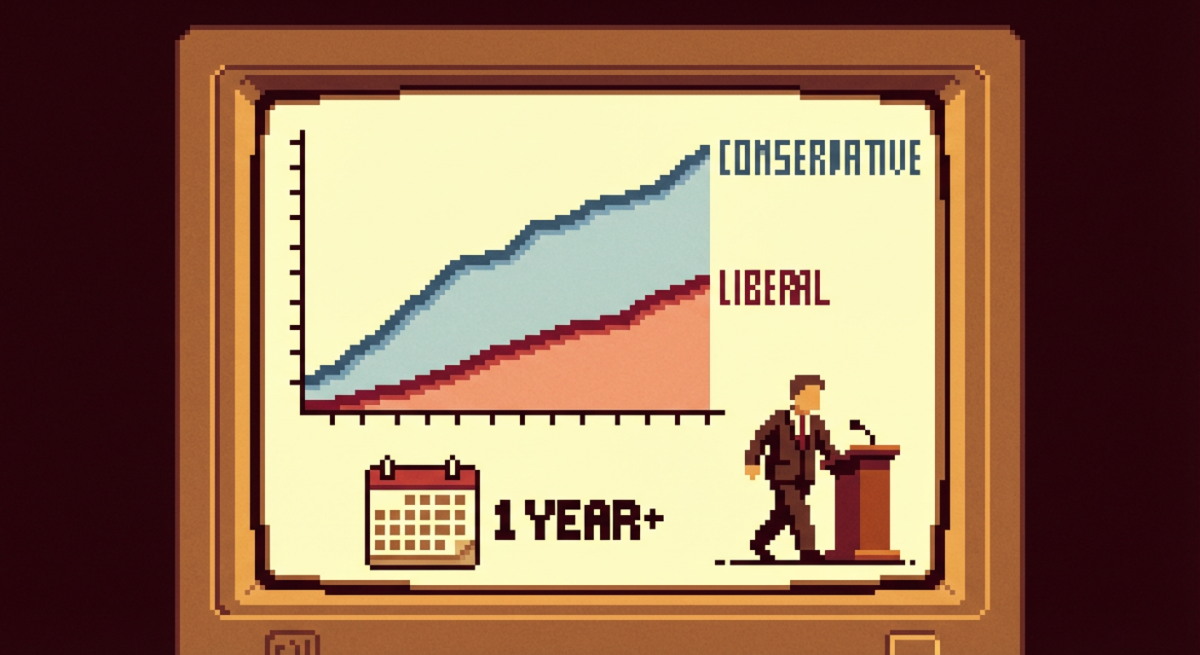
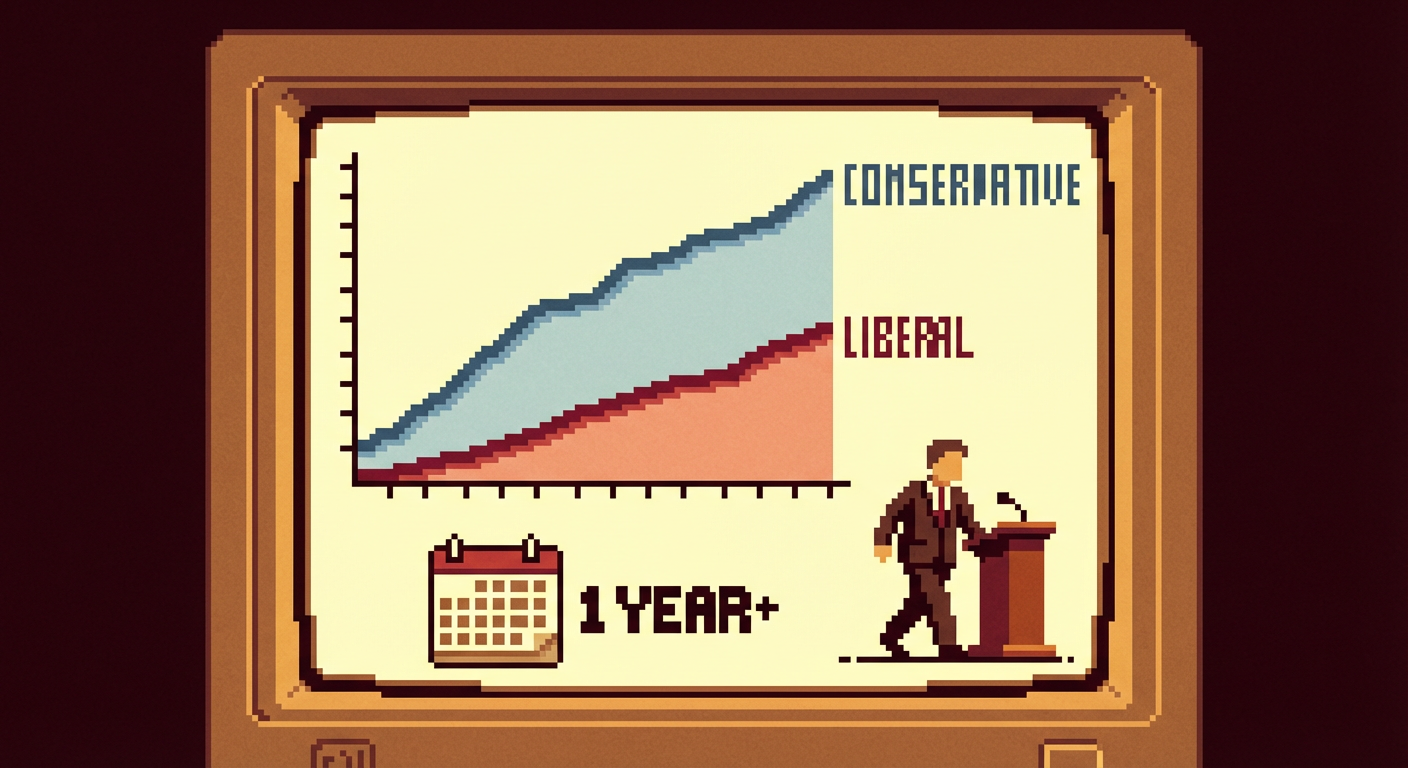
Pierre Poilievre’s Conservative Party had maintained polling leads of 15 to 20 points over the Liberals for more than a year before Trudeau’s resignation, according to tracking data from Abacus Data. This was not a recent development. It was a settled feature of the political landscape by the time Carney entered the race. The question then becomes: how much of that Conservative advantage was about Trudeau specifically, and how much reflected something deeper in the electorate’s orientation? If it was primarily personal, Carney’s appointment might reset the race. If it was structural, a leadership change alone would not be sufficient.
The answer likely involved both factors, but with the structural elements predominating. Voters had reached a point of diminishing patience with the incumbent government across multiple dimensions. Cost of living pressures. Housing unaffordability. Perceived governance fatigue. The tariff crisis simply crystallized anxieties that had been building for years. Carney’s credibility on economic management might stabilize some centrist voters, might convince fiscal conservatives that competent hands were back on the wheel. But it was unlikely to reverse a 15 to 20 point deficit on its own, especially when his opponent controlled a coherent message about change.
Economic Nationalism vs. Continentalism as Framework
The deeper question animating the 2025 election was not really about personalities or even specific policies. It was about Canada’s relationship with continental trade integration. The tariff threat forced a choice between two broad frameworks. Economic nationalism emphasized Canadian self-sufficiency, domestic industrial policy, and reduced dependence on American demand. Continentalism emphasized deeper North American integration, the value of free trade within the bloc, and the mutual benefits of specialization. This was not a debate you could win through superior management. It was a fundamental question about national direction.
Carney’s background positioned him firmly in the continentalist camp. His career had been built in institutions committed to open capital flows and multilateral trade. His entire intellectual framework emphasized the benefits of integration. But 2025 was a moment when economic nationalism was gaining traction precisely because integration had created vulnerabilities. When one partner can unilaterally impose tariffs using security rationales, the benefits of continentalism look different. The structural irony was that Carney’s greatest strengths as a leader, his international credibility, his comfort with capital flows, his track record in managing integration, were potentially liabilities in an election where voters were questioning whether continentalism had been a good bet for Canada.
What Remains Unresolved
The Carney appointment represented a genuine gamble. It assumed that credible technocratic leadership could restore voter confidence and rebuild the Liberal coalition. It rested on the belief that the 2025 crisis was fundamentally about managing complexity rather than choosing between fundamentally different national directions. Whether this assumption proved correct would depend on factors well beyond any individual leader’s control: whether the Trump administration moderated its tariff threat, whether the Canadian economy stabilized, whether the currency recovered. Structural factors that no appointment could guarantee.
For more detailed information on the electoral process and timeline, you can consult Elections Canada Official Federal Election Information. For ongoing analysis of how economic conditions shaped the political environment, the Bank of Canada Monetary Policy Reports provide crucial context. The 2025 election would tell us something important about whether voters believe in technocratic problem-solving during moments of structural crisis, or whether they are ready for a different approach to Canada’s place in the North American economy.