The Election That Reshaped German Politics
On February 23, 2025, German voters delivered a result that felt simultaneously predictable and disorienting. Friedrich Merz’s CDU/CSU secured approximately 28.5 percent of the vote, the party’s strongest performance in over a decade. Not a landslide, exactly. But context matters here. The Union parties edged back toward the political center after years of fragmentation had scattered the German electorate across an increasingly splintered field. What looked like a straightforward center-right victory was actually something more complex: a partial consolidation amid deeper structural instability.
The real story was in the runner-up position. The far-right Alternative for Germany finished second with roughly 20.8 percent, a historic high that nobody in Berlin’s political establishment could comfortably ignore. This wasn’t just a strong showing for an opposition party. It represented a fundamental shift in what counted as the political terrain itself. When an anti-immigration, euroskeptic force captures one-fifth of votes in Europe’s largest economy, coalitional mathematics become secondary to questions about democratic legitimacy and systemic resilience.
Merz inherited a peculiar mandate. He had won, but the victory opened no obvious path to governance. Every traditional coalition partner either rejected collaboration with the AfD (standard practice) or faced their own complications. The SPD, weakened but still necessary, carried the weight of the outgoing government’s unpopularity. The Greens had performed poorly enough to become junior partners rather than kingmakers. The math pointed toward a grand coalition, but grand coalitions carry their own vulnerabilities. They can appear exhausted. They can look like the establishment closing ranks against outsiders rather than demonstrating any positive vision.
The Coalition That Finally Took Shape
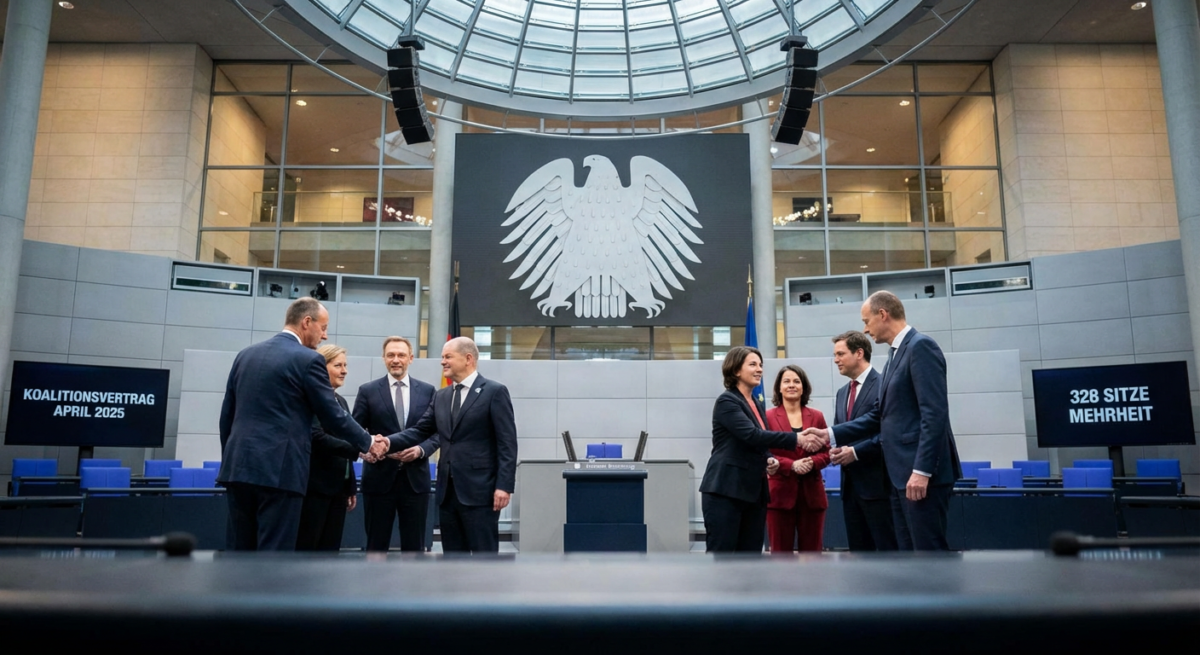
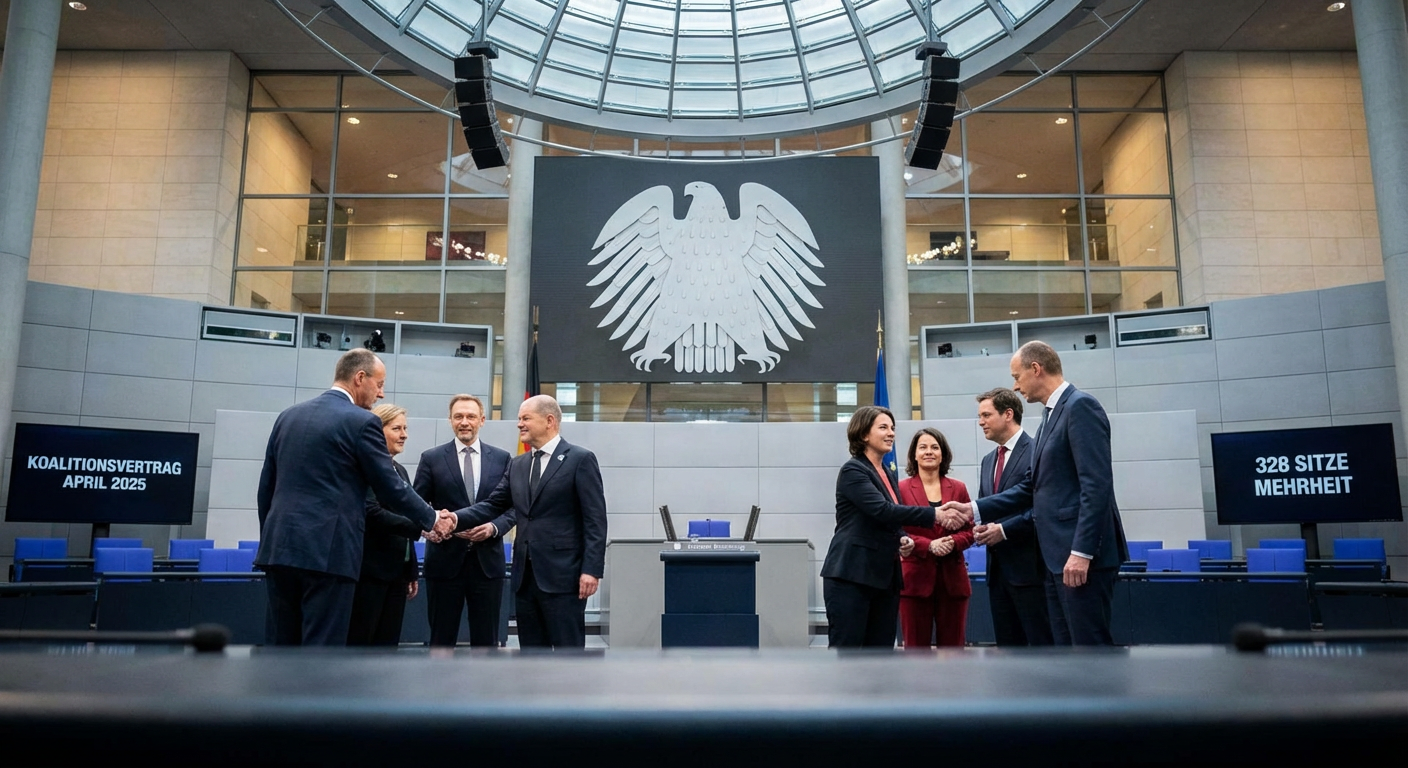
By April 2025, Merz and the SPD had formally confirmed their governing arrangement, securing 328 seats in the Bundestag. The coalition negotiations had consumed more than six weeks, an eternity in modern politics. Every day of delay carried risk. It signaled that even Europe’s supposedly most stable democracy couldn’t rapidly form a government, and it invited speculation about whether the traditional party system retained the flexibility to adapt to new electoral realities.
What makes this coalition historically notable is not its composition but its timing and the pressures that produced it. Merz didn’t choose to govern with the Social Democrats because he preferred their ideology. He did so because the arithmetic allowed no other serious option and because the AfD’s second-place finish created psychological urgency. There’s an old political science maxim: parties coalesce when the alternative seems worse than compromise. Germany’s 2025 negotiations reflected exactly this dynamic. Pragmatism elevated to statecraft, but pragmatism nonetheless.
The coalition agreement itself reads as a document of necessary trade-offs. Merz secured commitments on defense spending and infrastructure. The SPD extracted concessions on social spending and labor policy. Both parties agreed to move forward on climate policy without achieving the consensus either would have preferred on its own. This is how democracies often function at their margins, through mutual constraint rather than shared enthusiasm. The danger is that voters perceive the result as leadership by committee rather than leadership with conviction.
Breaking the Fiscal Constitution
The most consequential decision of Merz’s first hundred days came not through legislative debate but through constitutional suspension. In March 2025, his government pushed through a €500 billion infrastructure and defense package by activating the so-called escape clause of Germany’s constitutional debt brake. This requires exceptional circumstances and legislative supermajority support. The government invoked this extraordinary power and the Bundestag approved it, despite intense criticism from economists, fiscal conservatives, and even some within the CDU itself.
To understand why this matters, you have to grasp what the debt brake represents in German political culture. Adopted in 2009 during the financial crisis, it enshrines into constitutional law a commitment to structural budget balance. For Germans, this reflects something deeper than mere fiscal conservatism. It connects to historical memories of hyperinflation, postwar reconstruction, and the discipline that stable currency provides. The debt brake isn’t simply policy. It’s identity. When a conservative chancellor suspends it, even temporarily, he’s signaling that circumstances have shifted in ways that overturn foundational commitments.
Merz justified the suspension by pointing to dual crises: Europe’s security environment following Russian aggression in Ukraine, and Germany’s aging infrastructure. These are real problems. But here’s where things get complicated. Spending €500 billion through constitutional exception rather than ordinary fiscal adjustment means future governments inherit a precedent. If emergency circumstances justify suspension now, what prevents their use later? The debt brake’s credibility rests on its perceived permanence. Each suspension erodes that permanence, even when particular suspensions seem justified.
The Bundeswehr’s Transformation
Within the larger spending package sits a more focused military commitment. Germany’s defense budget is on track to reach 3 percent of GDP by 2027, exceeding NATO’s 2 percent benchmark. For anyone historically minded about European security, this is a profound reorientation. Postwar Germany deliberately constrained its military capacity, not out of weakness but as a deliberate choice to embed German power within multilateral institutions rather than develop unilateral strength. The 3 percent commitment signals that this era has ended.
Merz didn’t invent this trajectory. The shift began under Angela Merkel and accelerated under Olaf Scholz following Russia’s invasion of Ukraine. But Merz has committed to it institutionally and fiscally in ways that make reversal politically costly. The Merz government’s €500 billion spending package — Deutsche Welle locks in these defense commitments across multiple fiscal years. Germany isn’t becoming militaristic. But it is becoming conventionally powerful in ways that will reshape European strategic calculations for decades.
The historical parallel worth drawing is to the 1950s, when West Germany rearmed within NATO. That integration into Western institutions shaped German behavior for seventy years. Today’s rearmament occurs within a different security architecture but with similar stakes. Germany’s military development will influence whether Europe builds independent strategic autonomy or deepens its dependence on American security guarantees. Merz has positioned his government on the side of greater European strategic independence, though how this actually plays out depends on decisions made across the continent.
What Germany’s Turn Suggests About European Democracy
The coalition’s first hundred days reveal patterns that go beyond German particularity. When established parties face strong challenges from anti-establishment competitors, they respond through some combination of three strategies: absorbing the challenger’s themes, intensifying differentiation, or defensive coalition-building. Merz has pursued primarily the third. The CDU/CSU remains ideologically distinct from the AfD, and Merz has reinforced this through conspicuous anti-AfD rhetoric. But his government has also absorbed some security-focused themes, even while rejecting nativism.
The constitutional debt brake suspension carries implications beyond Germany’s borders. Other European governments facing pressure to increase defense spending and public investment may view the German precedent as permission. If fiscal constitutionalism can yield to emergency declarations, then what counts as an emergency becomes the crucial battleground. Spain, France, and others face their own versions of this question, and the answer Germany provides may establish templates that echo across the continent.
Finally, consider what the AfD’s 20.8 percent finish tells us about European democratic competition. It doesn’t mean democracy is failing in Germany. Germans voted, rules were followed, coalitions formed according to constitutional processes. Yet the result also reveals how substantially the center has shifted. Twenty years ago, an anti-immigration, euroskeptic party receiving such support would have signaled acute democratic crisis. Today it registers as one outcome among others. Whether this represents democratic resilience or democratic erosion depends partly on what comes next in Merz’s governance, and partly on factors beyond any single government’s control.
The question now before observers of German and European politics is whether Merz’s grand coalition can demonstrate that traditional parties remain capable of addressing voter concerns about security, prosperity, and national identity. The stakes extend well beyond Berlin. If established parties can’t respond credibly to legitimate anxieties, the space for anti-system challengers only expands. But if coalition governments can deliver tangible results while remaining genuinely democratic, they may restore some confidence in institutional politics. The next two years will be telling.
