
Germany’s Rightward Lurch Signals Deeper Structural Problems
Friedrich Merz is now Chancellor of Germany, and that simple fact masks a far more complicated crisis beneath it. The CDU/CSU won February’s federal election with 28.6 percent of the vote, a respectable but hardly dominant result. The real story lies in what happened everywhere else. The AfD, Germany’s far-right party, claimed second place with 20.8 percent—its strongest federal result ever. The SPD crashed to 16.4 percent, its worst performance since 1945. This wasn’t a normal election correction. It was a structural realignment.
Americans watching this unfold should recognize what’s actually happening: German voters weren’t choosing a new policy direction so much as they were voting in panic. The AfD’s surge didn’t emerge from nowhere. It grew from years of stagnant wages, manufacturing anxiety, energy price shocks tied to the Ukraine war, and a sense that established parties had lost control of events. The SPD didn’t collapse because Germans suddenly hated social democracy. It collapsed because the party in government had to implement unpopular choices—higher energy costs, defense spending commitments, integration pressures—and voters punished them for it.
Here’s what makes this consequential for American observers: Germany’s political upheaval is fundamentally about economic anxiety channeling into anti-establishment movements. That’s not unique to Germany. It rhymes with what we’ve watched happen repeatedly in American politics over the past decade. When voters feel economically threatened and believe their government can’t deliver solutions, they gravitate toward outsiders and protest parties. Germany is simply further along that trajectory right now.
The Money Question: Why Defense Spending Became the Real Election
The 2025 German election was ostensibly about economic recovery and immigration. In reality, it was about money—specifically, how much Germany would spend on its military and infrastructure, and who would bear those costs. This is where understanding political economy becomes essential for anyone trying to grasp European politics.
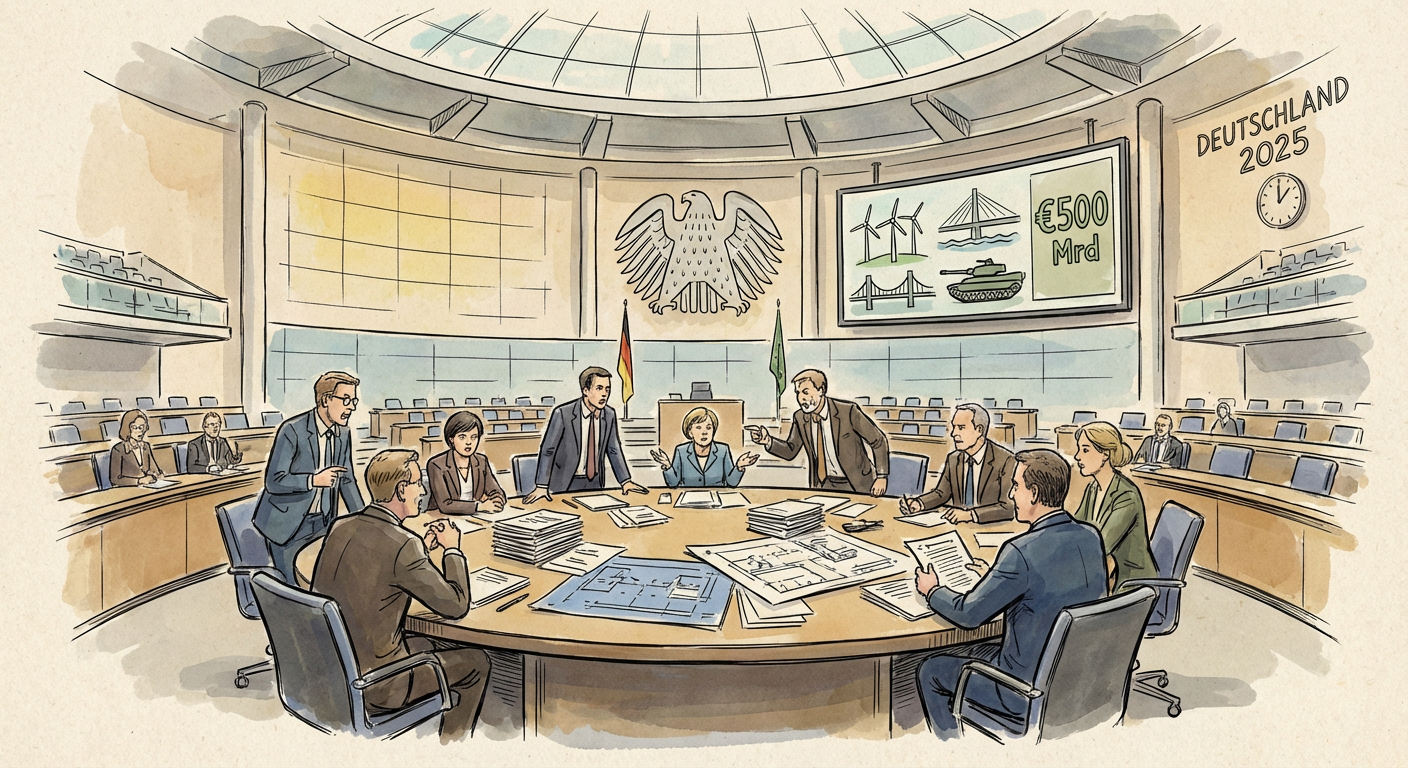
Germany had long committed to the NATO 2 percent defense spending threshold, a commitment born partly from American pressure. For years, Berlin treated this as aspirational rather than mandatory. Then Russia invaded Ukraine, energy prices spiked, and suddenly the defense number wasn’t theoretical anymore. In early 2025, the incoming Merz-led coalition debated a €500 billion infrastructure and defense investment fund. This wasn’t abstract policymaking. This was deciding whether German retirees would accept smaller pension increases, whether workers would see real wage growth, or whether business investment would be crowded out by government borrowing.
The coalition agreed to exceed the 2 percent NATO commitment for the first time. That sounds straightforward until you ask: where does the money come from? Politico Europe’s analysis of the Merz coalition detailed exactly how contentious this proved during negotiations. The SPD wanted to fund defense through tax increases on top earners and corporations. The CDU/CSU wanted to borrow more while maintaining lower taxes. This wasn’t an ideological debate about whether to strengthen NATO. It was a battle over whose income statement absorbed the costs.
Why should Americans care? Because this dynamic—military commitments requiring domestic fiscal choices that create political losers—is about to become central to American foreign policy conversations too. If Germany struggles with the political economy of higher defense spending, imagine the American debate when similar trade-offs emerge.
The AfD Problem Nobody Can Solve by Ignoring It
Germany’s mainstream parties faced a problem with no clean solution: the AfD, now representing one in five voters, could not be included in any coalition government because it violated fundamental democratic norms. Yet excluding 20.8 percent of voters from government formation creates its own legitimacy crisis. This is the razor’s edge European democracies are currently balanced on.
The incentives running through this are worth tracing carefully. The AfD gained voters by consistently warning about immigration and economic decline. Those voters felt ignored by existing parties. The existing parties couldn’t include the AfD in coalitions because the AfD had demonstrated genuine authoritarian sympathies and rejected liberal democratic commitments. So mainstream parties locked the AfD out, which vindicated the AfD’s core narrative: the system doesn’t listen to us because we’re not allowed to win. This feedback loop is self-reinforcing.
For American readers, this should trigger recognition. We’ve watched similar dynamics with political outsiders here—the pattern of exclusion creating resentment that strengthens the excluded party’s political base. Germany’s example suggests that simple electoral arithmetic doesn’t resolve this problem. Even with the AfD locked out of coalition negotiations, it remains powerful enough to constrain what coalitions can do. DW’s full 2025 German election results coverage included testimonials from voters who felt unrepresented regardless of which coalition formed. That dissatisfaction won’t evaporate just because a government took office.
What Germany’s Coalition Math Reveals About European Fragmentation
Merz’s coalition had limited options. The SPD, despite its catastrophic result, remained the largest available coalition partner. Alternative coalitions involving the Greens or the FDP were arithmetically possible but politically complicated. Every combination involved trade-offs. The CDU/CSU chose the SPD, which meant accepting some tax increase proposals and slower pension reform. The SPD accepted defense spending increases it had resisted in campaign messaging. Both parties got less of what they wanted.
This is what fragmentation looks like in practice. Germany’s multiparty system forces coalition compromise, which sounds democratic until you realize that voters didn’t choose a coalition—they chose parties, then watched politicians negotiate deals voters didn’t directly approve. The SPD’s voters didn’t vote for a defense spending surge. The CDU’s voters didn’t vote for higher taxes on the wealthy. Yet both outcomes emerged from coalition math. This creates a legitimacy problem distinct from AfD voters feeling excluded. It affects people whose parties actually participated in government.
The European Union watches German coalition dynamics carefully because Germany remains Europe’s economic engine. When German politics become more fragmented and unstable, EU policymaking gets harder. Merz needed to move quickly on infrastructure and defense commitments because delay meant political capital bleeding away. That pressure to move fast affected which EU initiatives got championed and which got delayed.
Why Americans Should Track German Politics Like It’s Their Own
The American political system remains structurally different from Germany’s—we have two parties, not ten, and we elect presidents directly rather than through parliament. But the underlying economic and political pressures creating instability in Germany exist here too. Stagnant wage growth for working-class voters. Rising defense commitments. Fiscal constraints limiting government spending on social priorities. A sense that established institutions aren’t delivering.
Germany’s election showed what can happen when these pressures accumulate without successful policy responses. The SPD wasn’t destroyed because German social democracy is inherently unpopular. It was destroyed because the government in power had to implement unpopular choices and voters punished the people making those decisions. American voters have shown similar patterns multiple times in recent years. The specific mechanics differ, but the underlying political economy is recognizable.
Watch how the Merz government navigates the next two years. Will the €500 billion investment fund actually produce economic growth that improves living standards? Or will it simply mean higher defense budgets and government debt without corresponding wage growth? Will defense spending crowd out investments Germans care more about? These aren’t theoretical questions. They’re tests of whether government can deliver material improvements in voters’ lives. If Merz’s coalition fails this test, the AfD gains legitimacy. If it succeeds, anti-establishment movements lose their opening. The outcome matters for Europe’s stability and, by extension, American interests in a stable Western alliance.
What’s your read on how long the Merz coalition holds together? I’m curious whether you see parallel dynamics in your own country’s politics, or whether Germany’s fragmentation looks genuinely unique from where you’re sitting.
